Solar System Fundamentals
The Solar System, our home star system, was formed approximately 4.6 billion years ago from the gravitational collapse of a nebula. Over 99% of its mass eventually concentrated in the Sun, our central star. The remaining material, through the system’s evolutionary processes, gradually formed the eight planets and planetary belts, which serve as the primary destinations for interstellar exploration in my sci-fi novel “Star Rider”.
At the core of the Sun, due to the immense gravitational forces generated by its massive mass, a process of nuclear fusion occurs where vast quantities of protons (hydrogen nuclei) fuse into helium nuclei, releasing high-energy X-rays and gamma rays. These high-energy photons, originating from the Sun’s core, take thousands to as long as 50 million years to reach the Sun’s surface. During this journey, they are gradually converted into visible light and lower-energy radiation before escaping into space. In essence, the entire Solar System’s energy originates from the Sun’s nuclear fusion process.
This brings us to the concept of the “nuclear fusion engine,” which is repeatedly mentioned in the novel. Such an engine operates using technology similar to that of the Sun’s nuclear fusion. This technological level serves as the foundation of the novel’s world. By this era, humanity has begun extensive exploration within the Solar System, constructing numerous satellite cities to harness and utilize energy resources.
Planetary Distances and Planetary Belts
How far are Jupiter and Saturn? Where is the asteroid belt? What about the Kuiper Belt? Why do Ami and Alcon’s missions take years? Let’s break it down.
Solar System Scale
A distance scale diagram illustrates the structure of the Solar System. On this diagram, the leftmost section represents the Sun’s surface. The horizontal axis proportionally displays the distances of the planets from the Sun (though the planet sizes are not to scale). You’ll notice that Mercury, Venus, Earth, and Mars are clustered close together on the left side, marked by red vertical lines. Beyond Mars lies the asteroid belt, which serves as a natural boundary dividing the Solar System into two regions:

- The Inner Solar System: Composed of rocky planets, including Earth, which is the third terrestrial planet from the Sun.
- The Outer Solar System: Beyond the asteroid belt, containing the gas giants—Jupiter, Saturn, Uranus, and Neptune.
- The red X-axis on the diagram includes two unit markers:
- 1.5 E8 km – 150 million kilometers, the standard Earth-Sun distance in kilometers.
- AU (Astronomical Unit) – One AU equals the Earth-Sun distance (150 million km).
With this unit in mind, we can estimate distances:
- The asteroid belt is relatively close, making it an ideal first exploration ground for DSF astronauts.
- Jupiter is about 5 AU from the Sun.
- Saturn is about 10 AU from the Sun—10 times the Earth-Sun distance.
- Uranus lies at 20 AU and Neptune at 30 AU.
- Beyond Neptune, at 33 AU, lies the beginning of the Kuiper Belt.
In the novel, Alcon’s DSF3137, equipped with a powerful Category KU-2 engine, travels across space at a safe speed, taking approximately 9 Earth days per AU. Even if traveling in a straight line with no course adjustments, reaching Neptune’s orbit (without even entering the Kuiper Belt) already requires nearly 300 days. This immense scale of time and distance plays a critical role in shaping the narrative of Star Rider.
Planetary Size Comparison
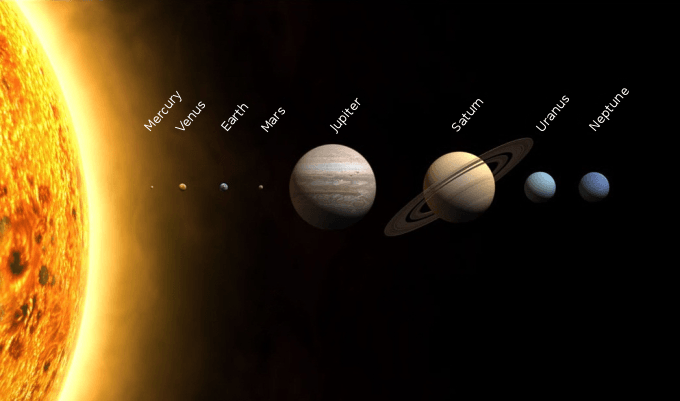
The previous distance diagram was not to scale in terms of planet sizes. A separate diagram illustrating true planetary proportions highlights the vast differences:
The tiny rocky planets—Mercury, Venus, Earth, and Mars—are minuscule compared to the gas giants.
Earth appears strikingly small in contrast to the behemoths like Jupiter and Saturn.
In the novel, Earth is sometimes referred to as the “home planet”. This tiny blue sphere in the vastness of space remains humanity’s cradle.

Asteroids Mining
In the novel, humanity has constructed numerous space cities primarily between Earth and Mars. This region offers an optimal solar distance for habitation but lacks abundant building materials. As a result, the nearby asteroid belt serves as a crucial resource hub for constructing space infrastructure. While the outer Solar System contains massive planets, they are gas giants and unsuitable for human settlement. However, many space cities have also been built on the rocky moons of these gas giants, despite the potential risks posed by asteroid and comet impacts.
According to human technological advancements, metal materials, with their excellent ductility and malleability, are the best engineering materials. So, can such metal materials be obtained from the asteroid belt? --- The answer is: Yes. Instead not all asteroids are suitable for resource extraction. Based on spectral analysis, asteroids fall into three primary categories:
- C-type (Carbonaceous) asteroids – 75% of known asteroids, primarily composed of carbon compounds.
- S-type (Silicaceous) asteroids – 17% of known asteroids, containing iron, magnesium, and silicon.
- M-type (Metallic) asteroids – Around 8% of the total number of asteroids in the asteroid belt, contain nickel and iron, believed to be remnants of planetary cores.
In Star Rider, C-type and S-type asteroid mining is still under research, while M-type asteroids are the primary targets for mining. Ami and Alcon, as exploration pilots, search for these asteroids, marking them with tracking beacons. Once identified, they become company assets, with tug ships towing them to designated mining locations for extraction and processing.
Beyond Neptune, the Kuiper Belt contains numerous celestial bodies, including Pluto, which was demoted to a dwarf planet. Due to its vast distance and high exploration costs, Kuiper Belt expeditions are more akin to territorial claims than profitable ventures. In Star Rider, Alcon is among the first explorers to enter this region, earning the title KU-2 certified pilot.
Lagrange Points
First, an important concept in celestial mechanics is the "Lagrange point." According to Wikipedia, a Lagrange point (also known as a libration point) is one of the five particular solutions to the restricted three-body problem in celestial mechanics.
Simply put, when two massive celestial bodies are in orbital motion, five equilibrium points emerge where smaller celestial bodies can achieve dynamic equilibrium. Many explanations refer to this as a "three-body" solution, but that is not entirely accurate. In the three-body problem, the three masses are usually of similar scale, whereas in the concept of Lagrange points, the focus is on "two massive celestial bodies and one or more much smaller bodies that do not significantly affect the gravitational environment.".
The simplified diagram of Lagrange points looks as follows: within the gravitational and dynamic environment created by two massive celestial bodies, five libration points labeled. These are commonly referred to as L1, L2, L3, L4, and L5. A small celestial body at any of these points can remain relatively "stable" or orbit around the corresponding equilibrium point.
Looking at our solar system, the Sun accounts for 99.86% of the system’s mass, and Jupiter alone is 2.5 times the combined mass of all other planets (see the planetary mass table below, sourced from NASA). We can apply the concept of Lagrange points to explain the motion of asteroids within the Asteroid Belt.
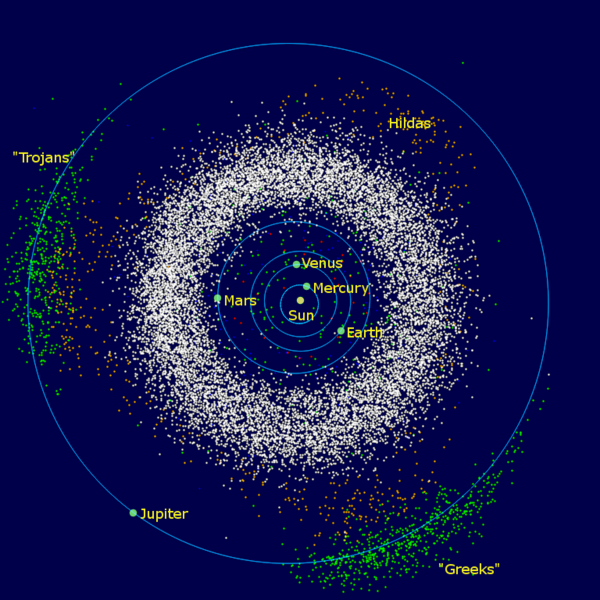
we used a top-down view of the ecliptic plane showing the asteroid belt. If we simplify that diagram, we get the following:
The white ring between Mars and Jupiter represents the Main Asteroid Belt. This asteroid belt is relatively close to the home planet - Earth, just beyond Mars’ orbit (though still over 2 AU away). This is the initial training ground for DSF pilots. However, looking slightly further out along Jupiter’s orbit (Jupiter is marked in the lower-right of the diagram), we find two additional groups of small celestial bodies labeled "Trojan Asteroids." Wait—why are they using Jupiter’s orbit?
These are the Trojan asteroid groups, which share Jupiter’s orbit and reside at L4 and L5. The L4 group was initially called the "The Greek asteroids" , though early naming conventions were inconsistent. As more Trojan asteroids were discovered, a structured naming system emerged, but some naming errors persisted. As a result, some Greek heroes' names appear among the Trojans, and vice versa. Regardless, these groups are located at the Sun-Jupiter L4/L5 Lagrange points, co-orbiting with Jupiter.
--- Start of Quote ---
Alcon's Journal # 12
Finally, after leaving the asteroid belt, we will need to perform one last major maneuver to adjust our trajectory to a relatively sparse and safe departure zone. This safe departure zone must allow us to take advantage of the gravitational pull of other planets on our future trajectory, while avoiding the Hilda and Trojan asteroid groups that are located at the Sun-Jupiter Lagrange points.
Mars evaluated the situation and confirmed that we have enough propellant to perform all of these maneuvers. Although Jupiter is not in our path this time, we will still need to avoid the Trojan asteroid group that shares Jupiter's orbit. By the time we reach Jupiter, the Galileo space habitat and the supply station on Amalthea(3th moon of Jupiter) will be quite far away, and there will be a lot of small celestial bodies blocking our view or hiding behind Jupiter, so we may not be able to see it clearly.
--- End Quote ---


Asteroid Belt Structure and Orbital Mechanics
During Alcon’s first Kuiper Belt expedition, he needed a safe route through the asteroid belt. Mars calculated a trajectory to avoid dense asteroid clusters. This brings us to another asteroid group—the Hilda asteroids. What are these?
Looking again at the more detailed ecliptic plane map from the previous chapter, you are now familiar with the white main asteroid belt and the green Trojan/Greek asteroids. The orange regions represent the Hilda asteroids. They form a triangular pattern—why?
The concept of Lagrange points appears multiple times in the novel. This celestial mechanics model explains many behaviors of satellites and asteroids and serves as a mathematical foundation for interstellar travel and space station construction.
Given our understanding of Lagrange points, we know there are Trojan and Greek asteroids corresponding to the Lagrange points L4 and L5 in the Sun-Jupiter orbit. But what about the asteroids positioned directly opposite Jupiter—could they be at L3?
Yes! The equilibrium points of the Hilda asteroids lie at L3, L4, and L5. Unlike the Trojan group, which shares Jupiter’s orbit, Hilda asteroids are located slightly inward. Their triangular distribution is dynamically stable. While each asteroid follows its own orbit, collectively, they maintain a stable triangular formation. Scientists have calculated the ideal orbits of the Hilda asteroids, as depicted below:
(Note: Orange = Sun; Blue = Jupiter; Black and Red = Orbits of two asteroids with eccentricities of 0.310 and 0.211, respectively.)
--- Start of Quote ---
Alcon's Journal # 21
After departing from Galileo#1, we reached the Amalthea supply station—an advanced space platform located on Amalthea itself. This station had a unique feature: a long collection tube that extended into the atmosphere of Jupiter. It was connected to a modified asteroid at Lagrange point L2 of Amalthea, serving as the station's gateway and flight control center. This supply station played a crucial role as the primary hub for humans venturing towards the outer regions of our solar system. In the future, with the establishment of the Uranus supply station, it was expected that humans would embark on exploring and potentially traversing the outer Oort Cloud.
Alcon's Journal # 31
The temperature outside the protective hull of 3137 plunges below minus 200 degrees Celsius. Life here feels delicate and fragile. Due to the abundance of asteroids near Neptune's Lagrange points, most exploration spacecraft steer clear of this region or navigate cautiously at low speeds. I find myself as the sole explorer in this vast expanse.
--- End Quote ---
An interesting real-world example: the recently launched James Webb Space Telescope (JWST) orbits at the Sun-Earth L2 Lagrange point. This location allows JWST to maintain a stable orbit while staying aligned with Earth for data transmission. Additionally, it remains shielded from direct sunlight, enabling its infrared instruments to operate at near-absolute zero temperatures for optimal deep-space observations. L2 was the ideal choice. For NASA’s orbital details, click here: https://webb.nasa.gov/content/about/orbit.html


Orbital Resonance
Orbital resonance is an effect in celestial mechanics where orbiting bodies exert periodic gravitational influences on each other when their orbital periods form a simple integer ratio. The concept is analogous to pushing a child on a swing—both the orbital motion and the swinging have a natural frequency, and when an external force is applied periodically in sync with this frequency, the cumulative effect can either amplify or disrupt the motion. Orbital resonance significantly enhances gravitational interactions between celestial bodies, allowing them to alter or constrain each other’s orbits.
In celestial mechanics, this translates to either a perfectly stable synchronized orbit between two bodies or the destruction of one body's orbit. In most cases involving asteroids, the latter scenario occurs—their orbits are disrupted, causing them to be ejected from their original paths or cleared out, a phenomenon known as “clearing the neighbourhood” or “dynamical dominance”.
Kirkwood Gaps and the Asteroid Belt
In Star Rider, when Alcon first travels to the Kuiper Belt, he must pass through the asteroid belt, where the term Kirkwood Gaps appears:
--- Start of Quote —
Alcon's Journal # 12
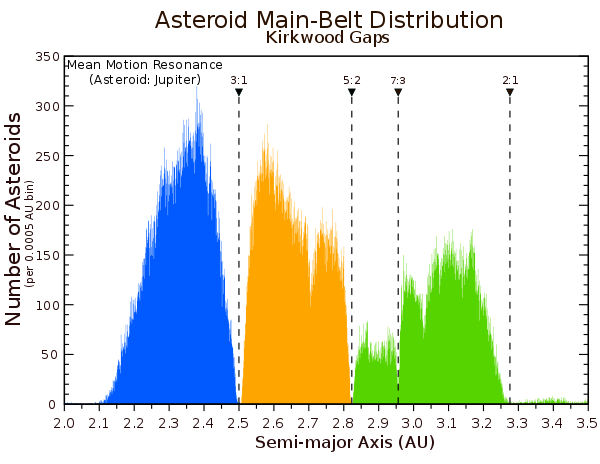
Even though we were traveling at a maximum speed of 150,000 kilometers per hour during our last mission, the new engine we installed can now reach speeds of up to 700,000 kilometers per hour. However, maintaining maximum speed through the asteroid belt is not wise, so 3137 will only accelerate in the Kirkwood gap, a relatively sparse region of the asteroid belt that is in resonance with Jupiter's orbit. Whenever we leave the Kirkwood gap and enter an area with a higher concentration of asteroids, we will need to slow down.
--- End Quote ---
A chart of the distribution of asteroid semimajor axes, showing the four most prominent Kirkwood gaps and a possible division into inner, middle and outer main-belt asteroids:
The principle of orbital resonance disrupting asteroid orbits also applies to planetary ring systems, such as the gaps within Saturn’s rings, where resonances have cleared out regions of dust and debris.

Stable Resonances - Laplace Resonance
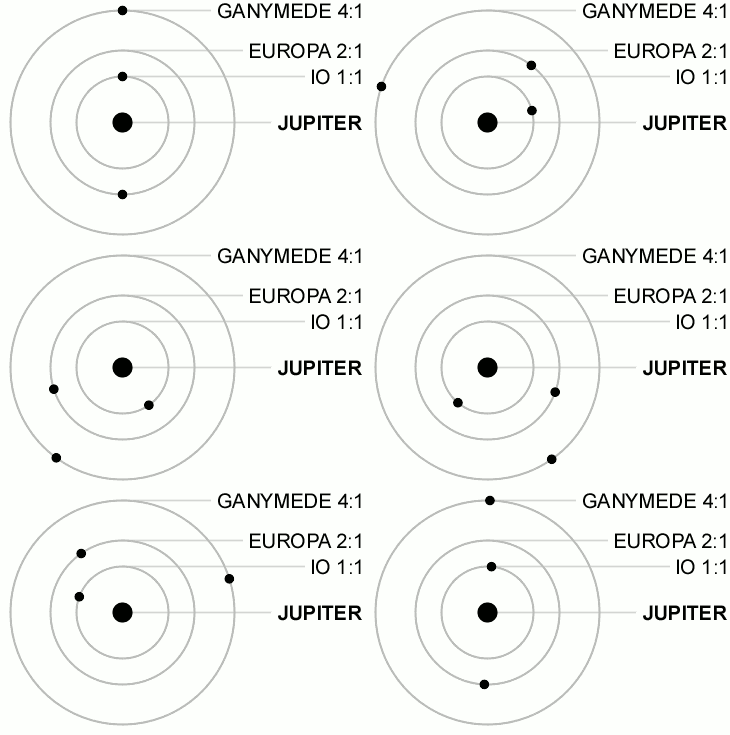
While resonance can lead to orbital destruction, it can also result in stable orbital configurations. A notable example is the Laplace Resonance among Jupiter’s three moons—Io, Europa, and Ganymede—which have established a stable resonant pattern in their orbits. The following animation illustrates this phenomenon:
Animation of Laplace Resonance:

Gravity Assist - The Slingshot Maneuver
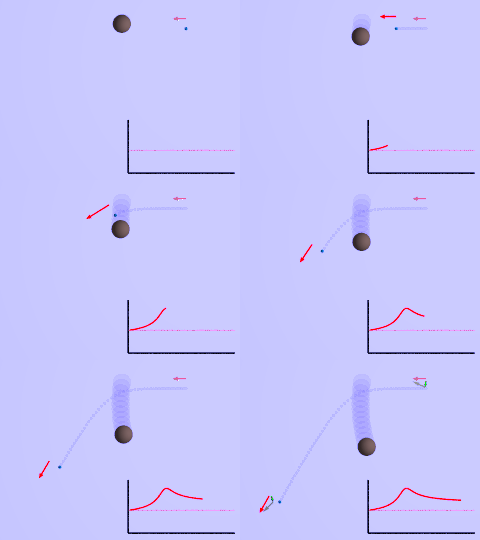
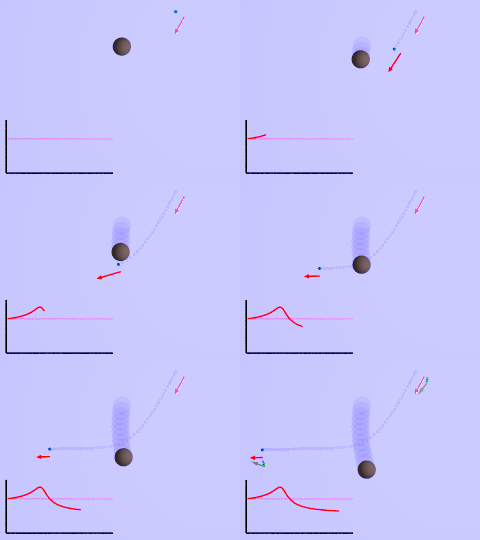
Since gravitational resonance occurs due to a massive planet’s influence on nearby smaller celestial bodies, it also affects passing spacecraft. This principle forms the basis of the gravity assist (or gravitational slingshot) maneuver, which allows spacecraft to gain or lose velocity by utilizing a planet’s gravitational field.
In Star Rider, Alcon explicitly references this maneuver:
In Alcon’s Journal #12, he describes using Saturn for a gravity assist acceleration toward the Kuiper Belt.
In Alcon’s Journal #14, he uses Jupiter for a gravity assist deceleration to reach Galileo I space station, a space station orbiting Jupiter.
The following animation illustrates the concept of gravity assist acceleration which is used by Voyager #1:

During this process, the most efficient acceleration occurs when propulsion is applied at the velocity peak. This effect is known as the Oberth Effect, which Alcon describes as follows:
--- Start of Quote —
Alcon's Journal # 12
I put my hand with the bracelet on it on the window, and Mars played some ambient music. I lost track of time as we flew by Saturn, and as the ship began to vibrate, Mars increased the engine thrust. We had now departed from the gravity assist trajectory.
Farewell, Saturn, dear father and mother. As we journey onwards, I shall carry you with me as we soar through the stars…
--- End Quote ---
The following animation illustrates gravity assist deceleration (Scenario #d):

Interstellar exploration in the novel frequently employs gravity assist techniques, as they are essential for interplanetary travel. These maneuvers enable spacecraft to conserve vast amounts of fuel, making them a standard practice. Recognizing the cost-saving benefits, the Deep Space Frontier (DSF) command center immediately approved Alcon and Mars’ request for the maneuver:
--- Start of Quote —
Alcon's Journal # 14
With the saved propellant, we can approach Jupiter more closely and save the company money. Moreover, the additional time required occupies my vacation time. The DSF control center almost instantly agrees. Mars shows me the operation permit of the DSF on one screen and makes a face at me on the other screen, saying, "This is the win-win game I have learned."
--- End Quote ---
Tidal Locking
--- Start of Quote —
Alcon's Journal # 18
I looked up at Jupiter hanging in the sky, partly illuminated by the sun like a huge crescent moon that was colorful and constantly changing. Due to gravitational locking, Jupiter appeared fixed in this location from the perspective of the greenhouse's position, but the shadows and bright spots on its surface changed continuously as time passed, depending on the angle at which the sun shone on it. I took off my parents' bracelet from my left hand and put it on my right, then continued to hug Ami tightly from behind.
--- End Quote ---
Tidal locking (also known as synchronous rotation or captured rotation) is a gravitational effect that causes a celestial body to always show the same face to the object it orbits. For example, the Moon is tidally locked to the Earth, meaning we always see the same side of it.
A tidally locked body takes the same amount of time to rotate once on its axis as it does to complete one orbit around its companion. This synchronous rotation causes one hemisphere to remain perpetually facing the partner body. Typically, only the smaller body—such as a moon—becomes tidally locked to a larger planet. However, if two celestial bodies are similar in size and mass, mutual tidal locking can occur, as seen with Pluto and Charon.
The tidal force or tide-generating force is the difference in gravitational attraction between different points in a gravitational field, causing bodies to be pulled unevenly and as a result are being stretched towards the attraction. It results in shape deformations due to mutual gravitational attraction. On Earth, this effect is most visibly seen in ocean tides, though the solid ground also experiences slight bulging. For the Moon, these forces have caused it to become locked with one hemisphere permanently facing Earth. Jupiter’s moon Europa is similarly locked, always showing the same side to Jupiter. Meanwhile, tidal heating occurs through the tidal friction processes: orbital and rotational energy is dissipated as heat in either (or both) the surface ocean or interior of a planet or moon. Due to tidal heating, Europa's interior remains relatively warm, possibly supporting a subsurface ocean. This concept is reflected in Star Rider, where Alcon and Ami dive into Europa's ocean for an adventure.
Warp Drive and Gravitational Wave Detectors
--- Start of Quote —
Alcon's Journal # 8
This famous gravitational wave detection system has been in operation and continuously observing for more than 30 years before being retired. The currently studied curvature propulsion is based on the theory and observation results of this system. According to predictions, it will take more than a decade for the available curvature engines to appear. LISA has been replaced by two sets of equilateral triangle gravitational disturbance detection systems, which are larger and more accurate and use heliocentric orbits. These two sets of equilateral triangles form a huge hexagonal system array named "Beacon I" and "Beacon II". In addition to gravitational disturbance detection, this huge heliocentric system is also used for information relay among various spacecraft, space habitats, and the home planet within and beyond the solar system.
--- End Quote ---
Gravitational Wave Detectors - LISA and Beacon I/II
Gravitational waves and warp drive are often related. Let's first explore gravitational wave detection. The principle behind these detectors is similar to the famous Michelson-Morley experiment, where a single beam of light is split into two perpendicular beams, reflected back, and then recombined to create an interference pattern. If the distances in both directions remain unchanged, the interference pattern remains stable. However, if space itself is distorted due to a passing gravitational wave, a phase shift occurs, causing detectable interference.
The first confirmed detection of gravitational waves created a scientific sensation a few years ago. The equipment used was the Laser Interferometer Gravitational-Wave Observatory (LIGO), a large-scale physics experiment and astronomical observatory. LIGO consists of two laser interferometers—one in Hanford, Washington, and the other in Livingston, Louisiana. By comparing data from both sites, researchers significantly reduce the risk of false detections. These interferometers are incredibly sensitive, able to detect minute distortions as small as one-ten-thousandth of a proton’s charge diameter.
The Laser Interferometer Space Antenna (LISA) is another gravitational wave detection project, initially a collaboration between NASA and the European Space Agency (ESA). Due to funding issues, NASA withdrew in 2011, leading ESA to revise the mission and rename it the Evolved Laser Interferometer Space Antenna (eLISA) in 2013. Unlike LIGO, which is Earth-based, LISA consists of a vast equilateral triangle of spacecraft following Earth's orbit, with each side spanning five million kilometers.
LISA is expected to become operational after 2030. In Star Rider, this system has already been retired and replaced by two larger heliocentric equilateral triangles forming a hexagonal detection network. With numerous spacecraft scattered throughout the solar system, some inevitably end up blocked from Earth by the Sun. Thus, this new system serves as both a gravitational wave observatory and a solar system-wide communication relay, akin to ancient China's beacon towers—hence the names Beacon I and Beacon II.


Fusion engine / Propellant-Based Propulsion
--- Start of Quote —
Alcon's Journal # 13
For a vessel like the 3137, which needed to perform exploration missions involving frequent changes in trajectory, acceleration, and deceleration, neither of these futuristic technologies could be used. Instead, we relied on the preliminary practicality of controlled nuclear fusion and the well-established propellant propulsion technology. The gaseous giant planets in the outer solar system, primarily composed of hydrogen and helium, served as excellent materials for fusion engines and a source of propellant. Jupiter and Uranus became our supply stations.
--- End Quote ---
Fusion energy itself isn’t a new concept—the Sun is a massive fusion reactor. Humanity demonstrated nuclear fusion upon detonating the hydrogen bomb, but achieving controlled fusion remains a significant challenge. The most promising approaches involve Inertial confinement fusion (ICF) and magnetic confinement fusion (MCF), though current technology can sustain controlled fusion reactions only for a few seconds or minutes. Recent breakthroughs have extended this duration beyond 1000 seconds, marking a crucial step toward viable fusion power.
For spacecraft propulsion, fusion engines typically use plasma propulsion, where high-temperature plasma is expelled to generate thrust. However, in Star Rider, DSF3137 frequently maneuvers, requiring significant thrust. Plasma-based propulsion, while fast, produces relatively low thrust. Thus, transferring fusion-generated energy into traditional propellant-based thrust would be more effective. Consequently, in the story, the crew often discusses replenishing propellant rather than fuel, as fusion fuel consumption is minimal compared to propellant mass.
Comet Orbits
--- Start of Quote —
Alcon's Journal # 31
During my exploration, I caught sight of another enigmatic comet, yet to be identified. Mars diligently calculated its orbital period to be approximately 12,000 years, given its current trajectory and velocity. Its tail, still indistinct, awaits further clarity. As it ventures beyond the confines of the Kuiper Belt and approaches the inner reaches of the solar system, the comet's material rapidly evaporates, stretching its tail into a resplendent display of luminosity. Perhaps, back on Earth, humans will marvel at its ethereal beauty, unaware that its existence is fleeting. Despite its extended orbital cycle, this celestial wanderer may fade away before it can fulfill its destined lifespan.
--- End Quote ---
As of late 2014, there were 314 officially numbered periodic comets in the solar system. However, unnumbered comets remain poorly documented. Cometary orbits vary widely, ranging from a few years to several million years. Short-period comets originate from the Kuiper Belt, while long-period comets are believed to come from the Oort Cloud. Some comets theoretically have periodic orbits but never complete them due to solar evaporation.
One noteworthy example is Comet 109P/Swift-Tuttle, which has a roughly 133-year orbit. Predictive calculations indicate:
- In 2126, it will pass 0.153 AU from Earth.
- In 2261, it will pass 0.147 AU from Earth.
- In 3044, it may pass as close as 0.011 AU, potentially resulting in an Earth impact.
Cassini-Huygens Saturn Exploration Mission
--- Start of Quote —
Alcon's Journal # 12
After a 20-year exploration mission, Huygens eventually fell silent on Saturn's moon, Titan, while Cassini plunged into Saturn's atmosphere as planned, completing its final observations and self-destruction mission on September 15, 2017, Earth time. As Cassini burned up while passing through Saturn's sky, lined with its massive rings, its story was permanently written into the history of space exploration, even though humans could not witness it with their own eyes.
--- End Quote ---
The Cassini-Huygens mission was a flagship-class space probe sent to explore the Saturnian system, a collaborative project between NASA (National Aeronautics and Space Administration), ESA (European Space Agency), and ASI (Italian Space Agency).
The mission was divided into two main components: Cassini, the orbiter that studied Saturn and its moons, and Huygens, the lander that descended onto Titan, Saturn’s largest moon. The two probes were launched together aboard a Titan IVB rocket on October 15, 1997, and arrived at Saturn in early July 2004. The Huygens probe separated from Cassini on December 25, 2004, successfully landing in the Adiri region of Titan on January 14, 2005. It became the first probe to land on a celestial body in the outer solar system, transmitting data from the surface.
Cassini, meanwhile, continued its mission, orbiting Saturn for over 13 years before finally executing its planned Grand Finale. On September 15, 2017, following mission directives, Cassini plunged into Saturn’s atmosphere, where it burned up, bringing the mission to an end.
Watch a simulation of Cassini's final descent into Saturn's atmosphere (3:55 total length). The final approach begins at 2:45 - https://youtu.be/68vxYRAony8
===============================================
*** Link to "Star Rider": https://www.wattpad.com/story/342470732-star-rider